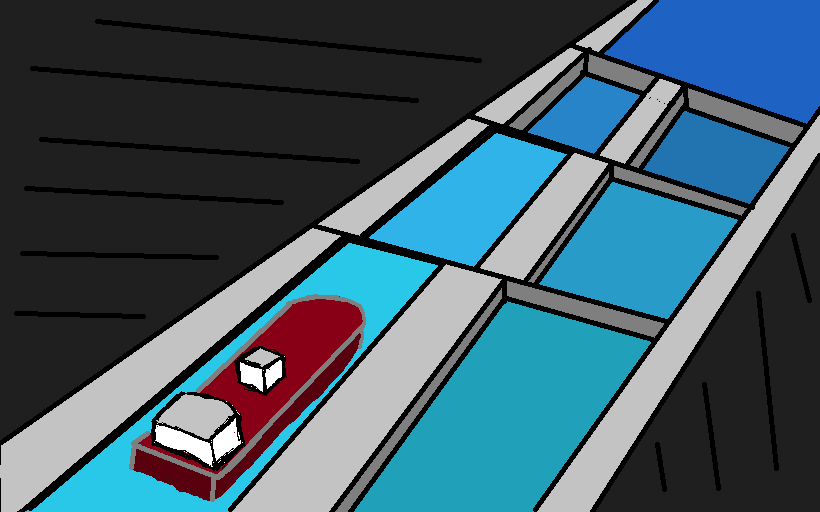
While highway accidents are reported every morning on local radio, and missing aircraft make international headlines every few years, the entire enterprise of seafaring – well, or ill – seems like a thing of the past. Ships do still constitute a major part of domestic commerce though, and accidents on the water still happen. They’ve just become extraordinarily rare.
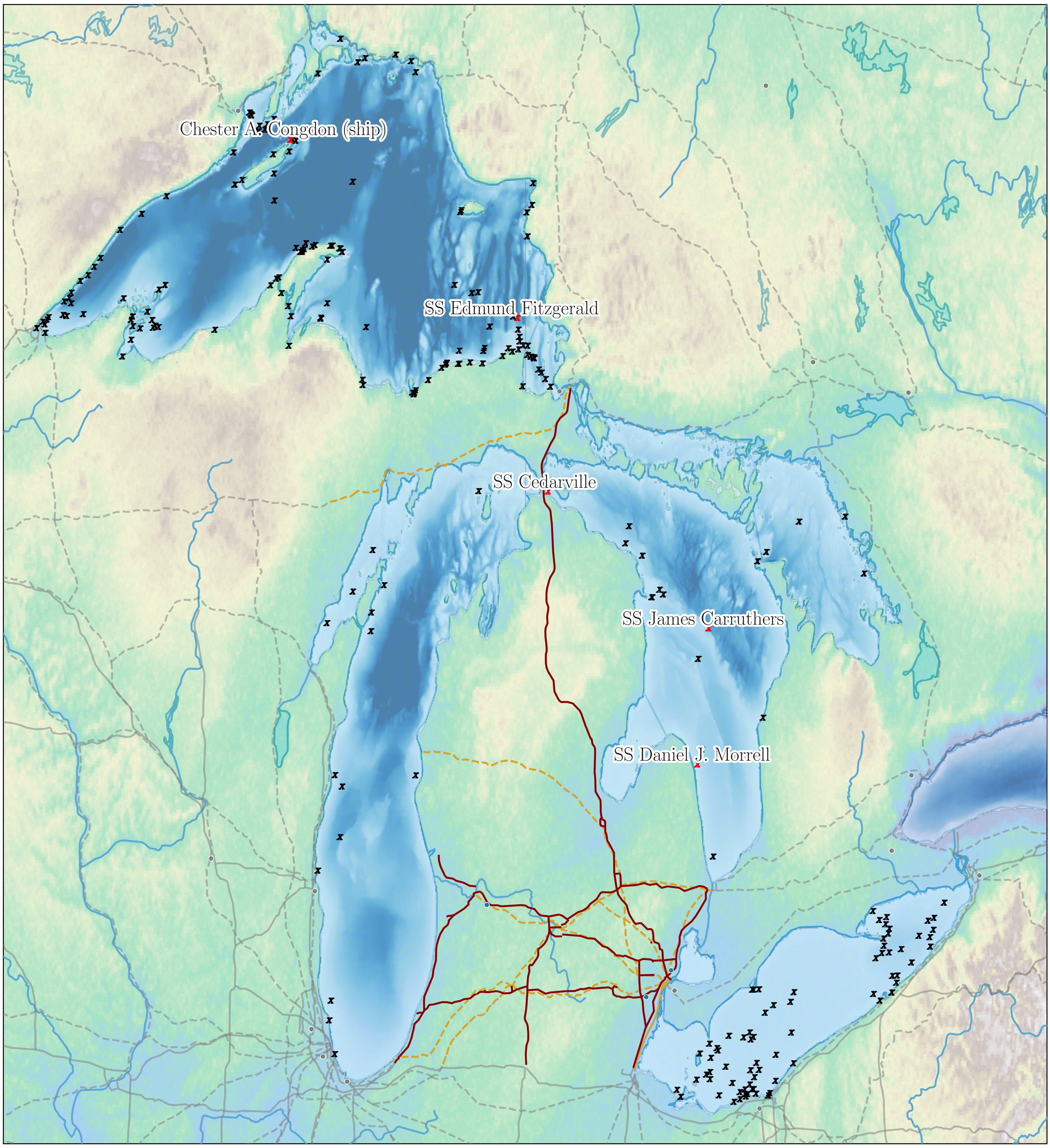
Figure 1: Marked in X are locations of every recorded shipwreck that’s taken place on the Great Lakes, excluding Lake Ontario (for aspect ratio-related aesthetic reasons). In red are the five largest wrecks.
The sinking of the SS Edmund Fitzgerald
A modern exception to prove the rule is the SS Edmund Fitzgerald. A “super laker”1 of 729 feet in length, “Fitz” was a feat of engineering at its time. (Perhaps reminiscent of the Titanic story, although being designed for commercial use it was probably never marketed as unsinkable.) Its fate was the loss of all hands on November 10, 1975 under intense rains and tossing waters of a well predicted storm. Its sinking is the stuff of folklore now.
Looking at historical data from the St Lawrence Seaway, the number of ships transiting that way had begun to fall from 1960. However, the lake fleet began to modernize at this time: the number of “super lakers” began to increase in the ’60s. This seems to suggest that, by proportion, bigger ships were becoming much more representative of the population on the water. (Note that tonnage is a concept that has shifted over the years, to avoid some ambiguity.) Why did Fitz sink? A contributing factor may be poor design. As reported by the National Transportation Safety Board in May of 1978, the cargo hold was flooded as the result of lake water heavily washing on board the deck. [cite] This was enough to apply continuous dynamic pressure against the hatch covers and bust them open. Once topside entry was available, the cargo hold then flooded totally as the transverse bulkheads – upright walls meant to compartmentalize the space – were not weathertight.
On the other hand, error in human judgment may also have played an important role. For example, the ship may have been under-maintained at the time. The US Coast Guard’s July 1977 report offers simply that “[t]his flooding most likely took place through ineffective hatch closures” and recommended that operators of Great Lakes vessels should undertake a “positive and continuing program of repair and maintenance.” [cite] Additionally, the report suggests that the fast and frequent nature of Great Lakes shipping voyages can confer a sense of complacency among captain and crew with powering through hazardous weather conditions.
Thirdly, policies of the day concerning allowed shipping volumes on the lakes may not have been calibrated for the relevant level of risk for every ship, Fitz included. A ship’s susceptibility to flooding is determined in part by its “freeboard,” which is the exceedence of a ship’s deck beyond the water level. If involved in commerce, the ship must sport a “load line” physically drawn onto its hull to indicate the minimum freeboard legally required for any voyage. Load lines are calculated with pure arithmetic derived by some geometry and based on empirical safety margins that have been accumulated in practice since the 1800s.
Calculating a load line
For simplicity, we will consider the calculation of the summer-time load line for a ship that is 400 meters in length. (The load line differs with season and water type, e.g. fresh v. tropical.)
First, the vessel’s tabular freeboard is \(F_T=221 + 16.1 L - 0.02 L^2\), where \(L\) is the “load line length” as determined by 96% of the total length of the vessel from fore side to rudder when measured at 85% of the least moulded depth, \(D\) (i.e. the minimum height of the hull). Depending on some safety criteria, \(F_T\) may be reduced.
Then, this baseline freeboard value may be updated according to several additive terms based on geometric criteria:
Block coefficient correction for less streamlined hulls when block coefficient \[C_B=\frac{\text{displaced volume}}{L\times \text{breadth} \times \text{draft}}>0.68,\] where the “draft” is the excedence of depth past freeboard, \(D-F\), defined implicitly in terms of the final freeboard computation;
Depth correction, \(\Delta F_D= (D-L/15)\times 250\), for vessels deviating from rule of thumb \(D=L/15\);
Superstructure correction, \(\Delta F_S\), based on a table, for reserve buoyancy resulting from enclosed superstructures;
Sheer correction, \[\Delta F_{sh}= \frac{3}{8} L\times (\text{aft sheer} + \text{forward sheer})\times \text{deviation from parabolic},\] for curvature of the deck from midship to the end;
(Add’l) Bow corrections for checking that the bow meets minimum height requirements.
The final freeboard is \[ F = g(F) := F_T \times \left(\frac{C_B(F) + 0.68}{1.36}\right) + \Delta F_D + \Delta F_S + \Delta F_{sh}. \] The load line is the maximum draft, \(\mathcal{l} = D - \hat{F}\), where \(\hat{F}\) is the implicit solution to \(\hat{F}=g(\hat{F})\).
Changes beget changes
A number of policy changes have taken place after the incident, summarized well on Wikipedia, and cargo carriage on the Great Lakes has taken a very different shape since then.
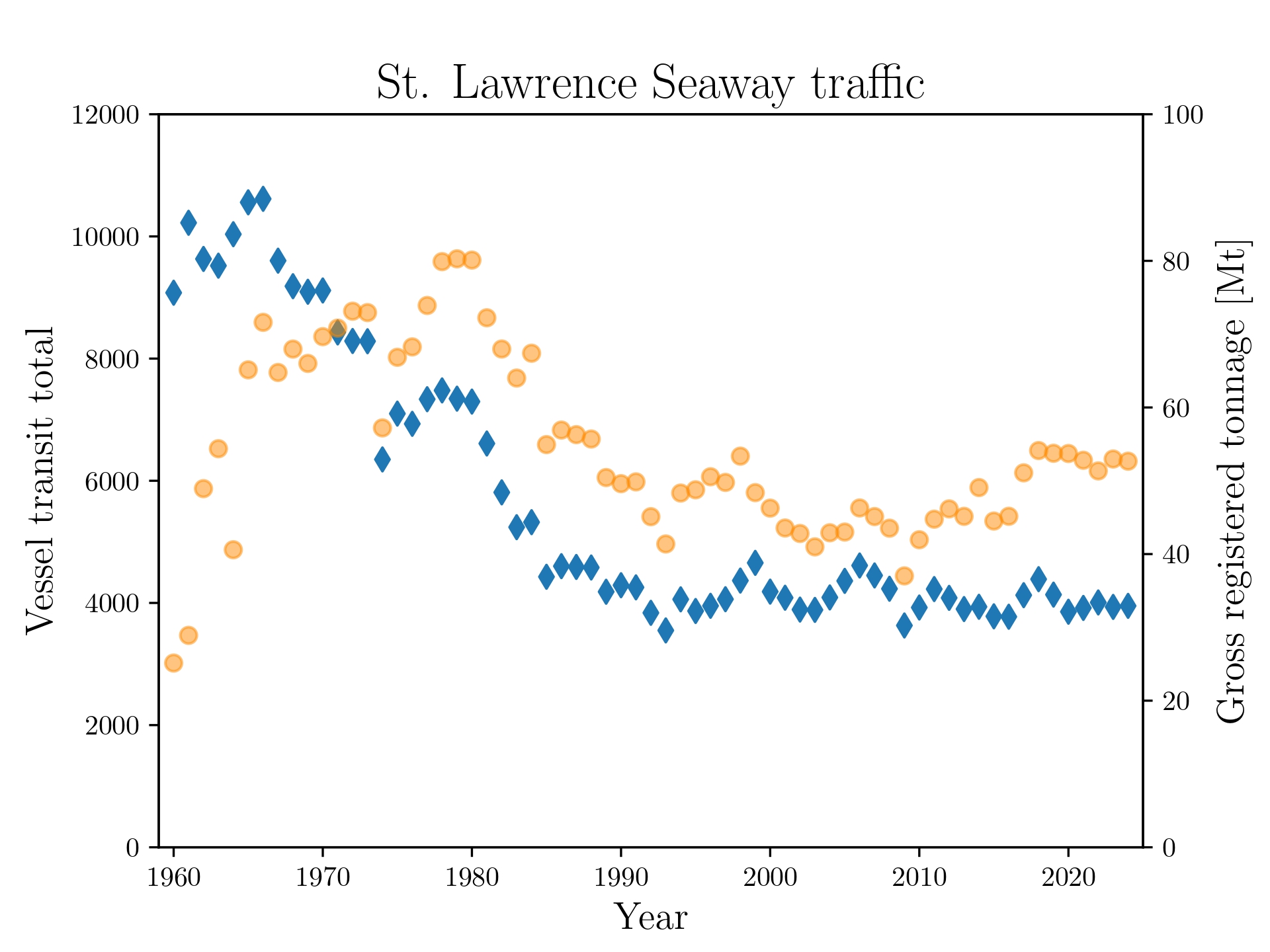
Figure 2: In blue are the number of vessels that have transited the St. Lawrence Seaway each year. In orange is the gross registered tonnage. Shortly after the gross registered tonnage spiked to meet its peak in the late ’60s through the 1970s due to the rise of super lakers, both the total number of vessels and their total tonnage overall began to fall to their fairly stable current levels.
Seeing that shipping has fallen in overall volume over the decades raises a question: Is it reasonable to conclude that shipwrecks have largely disappeared because policy changes have become more conservative with respect to the risks that sailors may legally take, and so fewer mistakes of judgment are made in practice? Has shipping become less prominent for other reasons, like that great lakers have made small-time shipping less profitable, or that the current policies are obstructively constraining, so other means of transportation are cheaper? Or has the broader, scarier, folklore-level articulation of uncertainty and risk related to shipping made regional engagement with the industry more hesitant and impersonal? Who knows, besides someone from another timeline where a rare event like the sinking of the Fitzgerald did not take place.
Fun fact: The LA Lakers started in Detroit (as the “Gems”; 1946-’47), then became the Minneapolis Lakers (after large ships on the Great Lakes; 1947-’60), then moved to LA.↩︎